The early childhood is a very crucial stage in the life of a child. Children learn most when they grow up. They acquire new abilities, have friends, learn about emotions, and know this world. Play is one of the most effective methods of learning for little children. Play is not only fun, but also one of the major avenues through which a child can train life skills.
What is Play-Based Learning?
Play-based learning refers to the learning that takes place because of play. Children do not merely sit at a desk and memorize facts, they experiment, explore new things whilst playing. Children are very natural in this kind of learning. They are inquisitive in nature and play is the one which gives them the opportunity to ask questions, solve problems and make sense of the surrounding world.
Play based learning may be of many different types:
- Imaginative play – acting something out, such as a doctor or a teacher.
- Physical play Running, jumping, climbing, body movement.
- Sensory play – touching, feeling, moving around textures, colors, or water.
- Cooperative play – play with other children and learn to share and cooperate.
In these activities, the children acquire valuable skills, which will assist them in school and in later life.
Why Play-Based Learning is Important
Play-based learning assists children in thinking, language, social, emotional, physical, and creative skills as they have fun and explore.
1. Helps Children Learn to Think
Children learn to think when they play and do not even notice them. To illustrate this example, piling blocks teach them balance and forms. Simulating to shop or babysit a baby assists them in making plans, making decisions and problem solving. These are mind powers that can be applied at school and in life.
2. Helps Children Talk and Listen
Playing, children learn to speak and hear. Playing games with their friends assists them in clarifying what they do, exchanging ideas, and learning new words. Talking is fun to do by telling stories, singing, and acting them out. Playing children tends to improve their speaking and listening more than children who merely do classes.
3. Helps Children Make Friends and Understand Feelings
Play educates children on self and others. Children learn how to share, take turns, and resolve problems when they play together. They also get to know how to be nice and assertive. As an example, playing with a friend on a sandcastle can make children learn to cooperate, listen and manage their emotions. Play provides children with an opportunity to express themselves and experience.
4. Helps Children Grow Strong and Healthy
The body of children is developed through playing. Balance, coordination, and strength are better at running, jumping, climbing, and playing with small toys. Outdoor play assists children to investigate nature and senses. The small muscles can also be developed by drawing or working with blocks because these are required in writing and in everyday activities.
5. Makes Children Creative and Imaginative
Play enables children to exercise their imagination. Inventing stories, drawing, or music makes them think of new things. Creativity assists children in resolving issues in life. Play has the benefit of children getting to experiment without fear of failure. This will make learning enjoyable and bring confidence.
Why Family Day Care is Great for Play-Based Learning
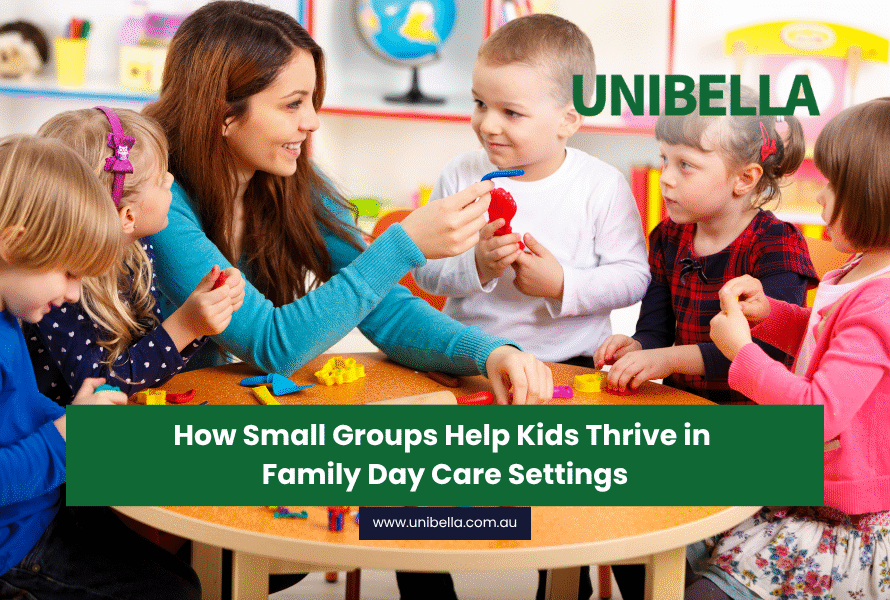
Family Day Care is a special form of childminding. It typically consists of small clusters of children, and this is what ensures more attention and support. Teachers are able to organize the activities according to the interests of every child and his/her needs. This makes it a more substantial and enjoyable way of learning.
At Unibella Child Care, our Family Day Care Scheme incorporates the use of play in assisting children to develop in all aspects; cognition, language, emotion, social behavior as well as physical growth. The environment provides children with the opportunity to discover, construct, and socialise in a safe and loving environment.
Instructors are significant. They monitor the interests of children, inquire with leading questions, and give motivating materials to learn. This freedom and guidance allow the children to learn on their own whilst receiving assistance where necessary.
How Play-Based Learning Helps Children in School
Play-based learning is not fun, but it is also one that prepares children to join school. It teaches them to:
- Work well with others
- Resolve issues and be innovative.
- Communicate clearly
- Control their emotions
- I have confidence in new ideas.
As early learning systems such as the Early Years Learning Framework (EYLF) in Australia indicate, children learn effectively by playing. The EYLF emphasizes children as confident, connected, and effective learners. Play enables children to achieve all these objectives unconsciously.
How Parents Can Support Play-Based Learning at Home
Children can be taught by their parents, even at home. Here are some simple tips:
- Use Open-Ended Toys – Toys such as blocks, clay and art supplies to allow children to invent in numerous ways.
- Free Play – Children should be given time to play freely without rules or schedules.
- Join in Play – Playing together teaches children that learning can be enjoyable.
- Promote Outdoor Play – Nature and outdoor play promote the exploration and health of children.
- Follow Their Interests – Children should be allowed to make their own choices of what they enjoy, enhancing learning and participation.
Conclusion
Play-based learning is one of the best ways for young children to learn. It helps them grow mentally, socially, emotionally, and physically. Through play, children develop skills like problem-solving, communication, teamwork, creativity, and confidence.
At Unibella Child Care, our Family Day Care Scheme focuses on play-based learning because we know children learn best when they are happy, curious, and engaged. By playing, children not only prepare for school but also develop a lifelong love for learning.
Investing in play is investing in a child’s future. When children play, they grow smarter, stronger, and more confident every day.